Start With the 'Why' Before the Formula: What Indonesian Physics Classrooms Get Right
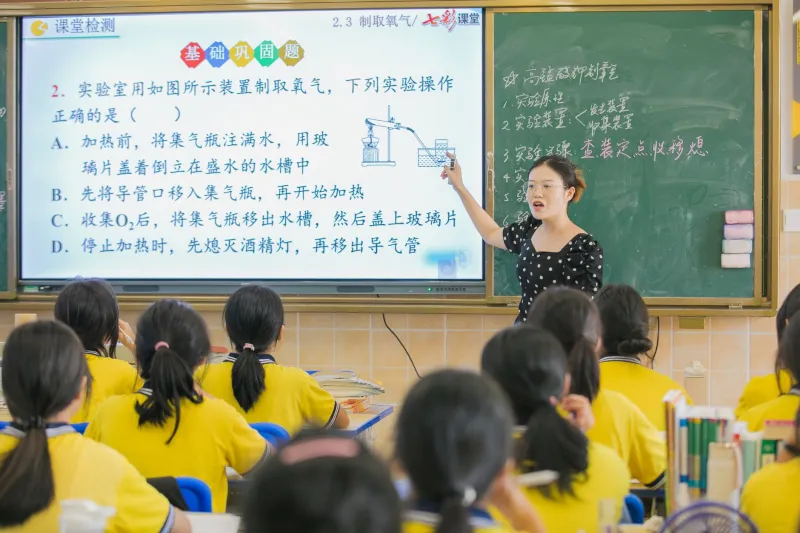
Picture this: a physics teacher walks into class, skips the whiteboard entirely, and instead asks students why a wet umbrella spins water off when you twirl it. No equations. No variables. Just a question about something every student has seen with their own eyes.
That's not an unusual opening in many Indonesian high school physics classrooms. And while it might sound like a small instructional choice, the ripple effects on how students understand — and actually remember — physics concepts are surprisingly significant.
The Sequence That Changes Everything
In a lot of American physics classes, the flow tends to go something like this: introduce the formula, define the variables, work through example problems, then maybe — if there's time — connect it to something in real life. It's a logical structure, but it puts the cart before the horse in a way that can leave students memorizing steps without really grasping what's happening.
Indonesian physics pedagogy, particularly at the SMA (senior high school) level, often flips this sequence. Teachers present a phenomenon first — something students can see, touch, or at least clearly visualize — and let the curiosity build before the math enters the room. The formula becomes an answer to a question students are already asking, rather than a rule handed down from above.
Think about the difference between being told "F = ma" and being asked why it's harder to push a loaded shopping cart than an empty one. Both paths lead to Newton's Second Law. But only one of them makes you feel like you figured something out.
What the Research Actually Says
This isn't just a feel-good teaching philosophy. Education researchers have been making the case for phenomenon-based or problem-first learning for decades. A concept called "productive failure," developed by researcher Manu Kapur at ETH Zurich, found that students who struggle with a problem before receiving formal instruction often outperform peers who receive direct instruction first — even when the initial struggle feels frustrating.
Similarly, studies in physics education research (PER) have consistently shown that students who are introduced to conceptual frameworks through real-world scenarios develop stronger mental models of physical systems. They're better at applying knowledge to new situations, not just reproducing the steps they memorized for the test.
The umbrella example from earlier? That's centripetal acceleration in action. But a student who figures that out through guided questioning is going to own that concept in a way that a student who copied the formula off the board probably won't.
Why US Classrooms Often Don't Do This
So if the evidence points toward real-world-first instruction, why isn't it more common in American high school physics?
Honestly, a few reasons — and none of them are about teachers not caring.
Curriculum pressure is real. AP Physics, state standards, and standardized testing timelines create a pace that feels incompatible with slowing down to explore a phenomenon before getting to the "actual lesson." When a teacher has 14 units to cover in 36 weeks, the exploratory warm-up can feel like a luxury.
Classroom management concerns. Open-ended, phenomenon-first lessons can get messy. Students ask questions the teacher didn't anticipate. Discussions go sideways. For teachers already managing 30 kids in a room, that unpredictability can be stressful, especially without strong institutional support for this kind of teaching.
Assessment misalignment. If the test asks students to solve for acceleration given force and mass, teachers reasonably focus their instruction on that skill. Phenomenon-based learning builds deeper understanding, but that depth isn't always what gets measured — and teachers know it.
Training gaps. Many physics teachers in the US were trained in content-heavy programs that emphasized subject mastery over pedagogical innovation. The "how to teach" part of their education may not have included much exposure to inquiry-based or phenomenon-first approaches.
What This Looks Like in Practice
Let's get concrete. Here are a few ways Indonesian-style phenomenon-first instruction shows up in physics class — and how they could translate to a US setting.
Buoyancy: Instead of opening with Archimedes' principle, a teacher places a heavy steel bolt and a small piece of foam in water and asks: which one sinks, and why does the foam float even though it's sitting on top of the water? Students debate, make predictions, and start building intuition. Then the formula gives that intuition a precise language.
Electricity: Before introducing Ohm's Law, students are handed a simple circuit kit and asked to figure out what happens to the brightness of a bulb when you add more batteries. They observe. They wonder. Then V = IR shows up as the explanation.
Projectile motion: Rather than launching into kinematic equations, a teacher drops a ball and throws another one horizontally at the same time from the same height. Which hits the ground first? Students guess. Most get it wrong. Now they're curious — and that curiosity is the best possible setup for what comes next.
None of these require special equipment or extra budget. They require a willingness to let the question lead.
The Student Experience Factor
Here's something worth sitting with: a lot of American students describe physics as intimidating, abstract, and disconnected from their lives. That perception doesn't come out of nowhere. If your first encounter with a concept is a symbol-heavy equation, and your job is to manipulate that equation to get the right number, physics starts to feel like a foreign language you're being graded on before you've learned the alphabet.
When students at Soal Jawab share their study struggles, one of the most common themes is exactly this — feeling like they're learning about physics rather than learning physics itself. The phenomenon-first approach addresses that gap directly. It positions students as observers and thinkers first, and formula-users second.
That shift in identity matters. A student who thinks of themselves as someone who notices things and figures them out is going to engage with the subject differently than one who sees themselves as someone trying to apply the right equation before time runs out.
Small Shifts, Big Payoff
Adopting this approach doesn't require overhauling an entire curriculum. It can start with a single lesson, one day a week, where the real-world question comes before the formal content. Teachers can work backward from their existing materials — asking, what phenomenon does this formula actually describe? — and build a brief opening around that.
For students studying on their own, the same logic applies. Before drilling practice problems, spend a few minutes asking yourself: where do I actually see this in my life? Friction isn't just a coefficient — it's why your sneakers don't slide when you plant your foot during a basketball game. Pressure isn't just P = F/A — it's why snowshoes work.
The formula will stick a lot longer when it's answering a question you were already asking.
Indonesian physics classrooms didn't stumble onto this by accident. It reflects a broader educational value: understanding before performance, curiosity before calculation. That's a value worth borrowing — no matter which classroom you're sitting in.